
Blockworks Research: As Ethereum recovers, what opportunities and challenges will Based Rollup bring?


Original author: Donovan Choy
Original translation: TechFlow

Ethereum loves Rollup. Recently, "based" Rollup has attracted much attention.
What is special about based Rollup? The core lies in its sequencer.
Traditional Layer-2 uses a centralized sequencer to process user transactions and submit them to Layer-1 for settlement, while based Rollup entrusts the sequencing task to the validators of Ethereum Layer-1. This mechanism is called "based sequencing".
This design has two major advantages: anti-censorship and enhanced interoperability.
By letting Layer-1 act as a sorter, Rollup based on Ethereum can provide the same liveness guarantees as the Ethereum mainnet while avoiding the censorship issues that may arise from a centralized sorter.
Read more: MagicBlock Open Sources a16z-supported "Short-lived Rollup" technology
Another important advantage is a significant increase in interoperability. Based on Rollup supporters (such as Justin Drake) call it " synchronous composability", that is, transactions on Ethereum can be synchronously ordered or bridged between different Layer-2.
In simple terms, smart contracts on a Rollup based on Ethereum can call other contracts on Layer-1 almost instantly within the same block, as if they were all on the same chain.
This synchronization and the idea of "money legos" is not new; it has always been an important part of Ethereum's original vision.
Read more: Rethinking Ethereum Consensus with Beam Chain
However, the current decentralized state of Rollup causes transactions between Arbitrum and Optimism to be asynchronous, which introduces uncertainty in fees. This uncertainty is further exacerbated by the fact that gas fees are calculated at different points in time, rather than uniformly calculated within the 12-second time slot of Ethereum blocks.
In addition to making Ethereum more interoperable, this mechanism also brings significant cost savings. Ahmad Mazen Bitar, technical lead at Nethermind, explained:
"Users can initiate a transaction on Layer-1, complete the operation using the deep liquidity pool of Layer-2, and then return to Layer-1. This synchronous composability makes the whole process more efficient."
Currently, the largest based Rollup is Taiko, which has seen significant growth in both its TVL and daily transaction volume this month.
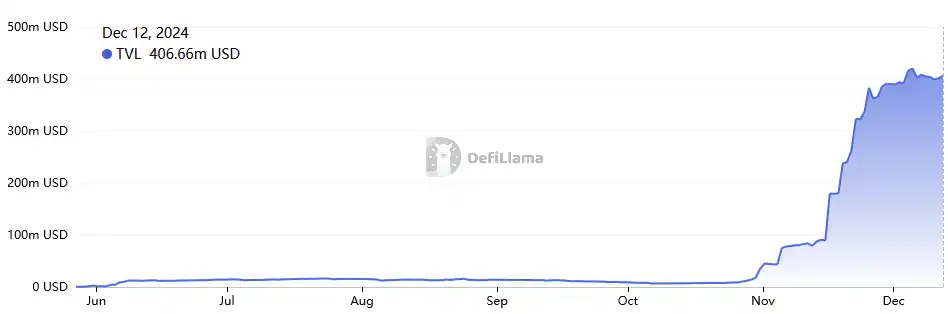
Source: DefiLlama
Other early based Rollup projects are also under development, such as Surge by the Nethermind team and UniFi by the Puffer Finance team. These projects are all based on the Taiko fork.
Nevertheless, based Rollup also faces some challenges. Since the sorting task is handed over to the Layer-1 validators, its performance is limited by the 12-second block time of Layer-1.
Therefore, the advantages of based Rollup (such as synchronous composability) may be difficult to fully realize in practice. It requires real-time zero-knowledge proofs to be completed within a 12-second time slot, otherwise composable transactions cannot be executed quickly.
To this end, Taiko introduced a variety of technologies, including zk proofs from Risc Zero and Succinct Labs, and a trusted execution environment (TEE) based on Intel SGX. This makes Taiko the first based Rollup to implement multiple proofs in a production environment without relying on a single trusted party.
"The performance of the prover is improving rapidly. We see more trusted execution environments (TEEs), more efficient and lower-cost zero-knowledge virtual machines (zkVMs), and verifiable state machines (AVSs) being introduced. We believe that the progress of zk technology is very smooth, and the goal of generating proofs within sub-time slot delays is not far away," said Brecht Devos, co-founder of Taiko, in an interview with Blockworks.
However, based Rollup also faces some challenges. For example, without a centralized sorter, an important source of revenue, MEV (maximum extractable value), may be lost. However, Devos said that this problem can be solved in some innovative ways.
In the Taiko network, "MEV can be captured by auctioning 'execution tickets' to Layer-1 block proposers," Devos explained to Blockworks.
So while Rollup based on staking gives ordering rights to Layer-1 validators by default, this is not the only solution.
Matthew Edelen, co-founder of Spire Labs, a company focused on Rollup infrastructure, shared a similar sentiment in a recent Bell Curve podcast: "Auctions are not the only way to allocate ordering rights. We can allocate 99% of ordering rights through auctions while allocating the remaining 1% to friends or independent stakers to present a better image on L2Beat."
In the long run, MEV (maximum extractable value) may not be a major problem. This view stems from a simple cost-benefit analysis: currently, most of the blockchain's revenue comes from congestion fees, which far exceeds the revenue of MEV. Moreover, as more efficient MEV solutions continue to emerge, the proportion of MEV revenue is gradually decreasing.
Therefore, for Rollup, a better revenue model is to rely on the network effect brought by synchronous composability and benefit from congestion fees rather than relying on MEV charges.
As Justin Drake said in The Rollup podcast:
“Right now, the ratio of congestion fees to contention fees is about 80:20. Of the revenue on Ethereum mainnet (Layer-1), 80% comes from congestion fees - about 3,200 ETH per day since the implementation of EIP-1559. Since the merger, MEV revenue has been about 800 ETH per day. I think this ratio will become more disparate, perhaps from 80:20 to 99:1.”
To sum up, the advantages of Based Rollup bring Ethereum’s user experience back to its original state.
Interestingly, this return is actually reminiscent of the characteristics that blockchain has had since its inception. Synchronous composability and Layer-1 transaction ordering have been core features of blockchain since the birth of the Bitcoin network.
This divergence of execution layer responsibilities is largely due to the centralized development path of Rollups in recent years (as well as the multi-chain architectures of Polkadot, Cosmos, and Avalanche). Today, Rollup-based solutions are ready to recapture this original intention.
「Original source」
You may also like

From Casino Tools to Global Pricing Machines: The NYSE Leader's Perspective on Hyperliquid

A Detailed Analysis of "Stock God Serenity" Investment Methodology

Sharplink CEO: The future of Ethereum is unfolding
Morning Report | Korea Investment & Securities and OKX plan to jointly acquire 40% of Coinone; Polymarket denies implementing KYC comprehensively; Grayscale delays U.S. stock IPO plans
Bit Digital CEO: Why I Bought More ETH

A Decade of Three Waves of Stock Tokenization from Bitget's Reality: An Unfinished Financial Exploration

"Hu Run Baifu" Dialogue with Sun Yuchen: A New Paradigm of Value Circulation in the Web3 Transformation Cycle

Is it hackers and regulation that ruined DeFi?

Chris Lee: From crypto OG to heavy investments in the three storage giants, predictions on AI bull market corrections, Web4, and opportunities for the younger generation

Ready for a Walk on the Wilder Side of Proof of Talk 2026? Join WEEX Labs in Paris

Gold vs Bitcoin in 2026: Which Market Is Giving Traders Better Opportunities?

Morning News | Coinbase partners with Standard Chartered Bank to expand multi-currency fiat channels; Sharplink and Forward will be included in the Russell Index; JPMorgan may issue stablecoins in the future

Hash Global Founder: Why I Also Chose to Liquidate All My ETH?

Tokenized US Stock Duel: Ondo vs. xStocks, Who is Defining On-Chain Nasdaq?

He Yideng ranked: Since you're here, you might as well
The era of regulatory arbitrage has come to an end, and the value of cryptocurrency exchange licenses is being fiercely contested
Six Major Complaints from an Ethereum Developer

The truth about global payments has been revealed by Airwallex
From Casino Tools to Global Pricing Machines: The NYSE Leader's Perspective on Hyperliquid
A Detailed Analysis of "Stock God Serenity" Investment Methodology
Sharplink CEO: The future of Ethereum is unfolding
Morning Report | Korea Investment & Securities and OKX plan to jointly acquire 40% of Coinone; Polymarket denies implementing KYC comprehensively; Grayscale delays U.S. stock IPO plans
Bit Digital CEO: Why I Bought More ETH
A Decade of Three Waves of Stock Tokenization from Bitget's Reality: An Unfinished Financial Exploration

Contents
Popular coins
Latest Crypto News


